Choosing a Deep Well Submersible Pump requires more than matching a motor size to a well depth. The correct choice depends on water level, required flow, pipe length, power supply, and total dynamic head. A pump installed 120 meters underground may face different conditions from one serving a shallow household well. Small details matter.
Experienced installers usually measure the static water level and observe how far it drops during pumping. They also inspect sand, iron, and other particles that may damage impellers. A pump’s performance curve should be checked against the real operating point, not just its maximum capacity. Ask for tested specifications, service guidance, and clear warranty terms. Reliable manufacturers explain both strengths and limitations.
A neat calculation can still be wrong. I have seen systems with powerful motors deliver weak pressure because the discharge pipe was too narrow. That mistake wastes energy. It also increases wear. Consider voltage stability, cable length, cooling requirements, and protection against dry running. Leave room for maintenance, even when the well casing feels cramped. The cheapest Deep Well Submersible Pump may become expensive after repeated repairs. Good selection balances efficiency, durability, water demand, and local service support. It should work quietly at the wellhead and consistently at the tap. That practical result matters most.
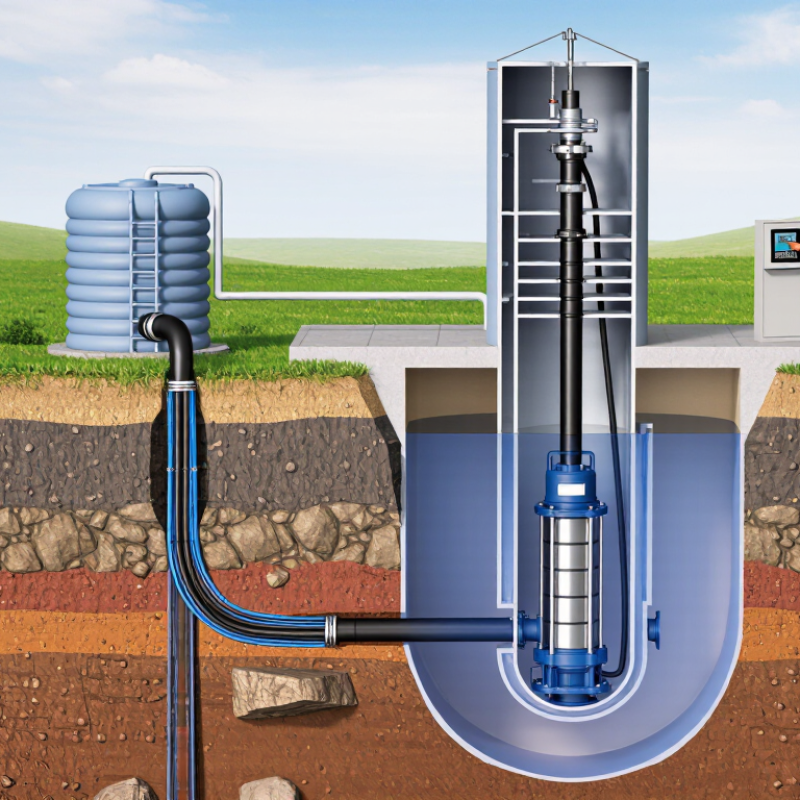
Choosing a deep well submersible pump starts with the water source, not the pump catalog. Measure the well’s total depth, casing diameter, static water level, and recovery rate. Then inspect the water. Sand, iron, hardness, and acidity can shorten pump life or clog narrow passages. A laboratory test is more dependable than clear-looking water.
Define demand in liters per minute instead of guessing. Record the number of outlets, irrigation zones, storage tanks, and operating hours. The pump must lift water from the dynamic level, when pumping begins, to the delivery point. Add pressure requirements and pipe friction, especially through long horizontal runs or small pipes. A field log can track flow, pressure, voltage, and water level at ten-minute intervals. This evidence is useful.
Select a pump whose tested operating point matches the required flow and total head. Do not choose the highest horsepower automatically. Oversizing may cause cycling, excessive electrical draw, or rapid well depletion. Undersizing creates weak pressure and long running times. A neat spreadsheet can still be wrong. Seasonal water levels and imperfect measurements may change the result. Sometimes the well yield is the real limitation, not motor capacity. That finding may support a smaller pump, a storage tank, or slower irrigation.

Choosing a deep well submersible pump begins with matching capacity to actual well conditions. Pump selection depends on water demand, lift, and pressure requirements. Measure the static water level before sizing the pump. Then estimate the pumping water level during peak use. Add the vertical lift from the water level to the tank, plus pipe friction and required household pressure. This total is called total dynamic head.
Do not size from well depth alone. A 300-foot well may have water at 80 feet. A 120-foot well may experience severe drawdown. Both need different pumps.
Estimate demand by listing fixtures that may operate together. A typical home may require 8 to 12 gallons per minute during peak use. Add irrigation, livestock watering, or workshop equipment separately. However, peak demand should not equal continuous pump output. Oversizing can cause rapid cycling, poor cooling, and unnecessary power use.
Check the pump curve at your required head, not only its advertised maximum flow. A pump producing 12 gallons per minute at low lift may provide only 7 gallons at deeper pressure. That difference matters.
Field testing improves reliability. Record well recovery after several hours of pumping. A neat calculation can still miss seasonal shortages. I have seen pumps selected correctly on paper but starved during dry months.
Leave a modest safety margin, then verify motor size, cable length, tank volume, and pressure-switch settings with a qualified installer. If water demand may grow, allow for that change, but avoid guessing wildly. Sometimes a smaller pump with a storage tank performs better than a larger pump forced to work beyond the well’s sustainable yield.
How to Choose a Deep Well Submersible Pump
Start with the power supply, not the pump catalogue. Record voltage, phase, frequency, breaker capacity, and cable length at the wellhead. Measure voltage while the pump starts, because a stable reading with no load can mislead. The U.S. Department of Energy reports that pumping systems can represent about 25% of industrial electricity use. Correct sizing therefore affects both reliability and operating cost. NEMA MG 1 also warns that voltage imbalance can create much greater current imbalance. Small electrical errors become expensive underground.
Measure the well casing’s actual inside diameter, not its nominal label. A few millimeters of rust, scale, or crooked casing can restrict cooling water around the motor. Leave clearance for installation and retrieval, according to the pump’s technical requirements. Confirm the pump’s outside diameter, intake position, cable route, and discharge connection together. The U.S. Geological Survey’s groundwater guidance stresses that drawdown and well construction influence dependable yield. A high-head pump cannot fix a weak well.
Check static water level, pumping water level, total head, and the well’s tested yield. Do not select from depth alone. A pump set too low may collect sediment; set too high, it can lose water during peak demand. In field practice, installers sometimes trust old well records too much. That is a mistake worth admitting. Re-measure before ordering, especially after drought or casing repairs. Keep space for a torque arrestor, safety cable, and service access. Small dimensions matter.
| Selection Dimension | What to Check | Typical Data or Requirement | Practical Selection Guidance |
|---|---|---|---|
| Power supply voltage | Confirm the available electrical service before selecting the motor. | Common systems include 230 V single-phase and 400 V three-phase at 50 Hz; 230 V or 460 V three-phase systems are also used at 60 Hz. | Choose a motor rated for the actual supply voltage, phase, and frequency. Do not connect a motor to a different supply without suitable engineering approval. |
| Electrical current and cable sizing | Check the motor full-load current, cable length, conductor size, and allowable voltage drop. | Longer cable runs create greater voltage drop. The cable must be rated for continuous submersible use and the motor's operating current. | Use the motor manufacturer's current data and local electrical code to size the cable, overload protection, and disconnect device. |
| Motor power | Match motor output to the required flow, total dynamic head, and water temperature. | Small domestic well pumps are often approximately 0.37–2.2 kW; larger irrigation systems may require more power. | Select from the pump curve rather than choosing by motor power alone. Oversizing can increase cost, cycling, and well drawdown. |
| Required flow rate | Determine the required delivery rate for fixtures, storage tanks, irrigation zones, or process equipment. | Residential demand is commonly specified in litres per minute or cubic metres per hour; 1 m³/h equals approximately 16.7 L/min. | Choose the operating point near the efficient portion of the pump curve and keep the rate within the well's sustainable yield. |
| Total dynamic head | Add the vertical lift, required outlet pressure, pipe friction, valves, filters, and other losses. | For water, 10 m of head is approximately equal to 1 bar of pressure, before accounting for friction losses. | Use the actual operating head at the required flow. A pump that reaches the required lift but not the required flow is undersized. |
| Well casing inside diameter | Measure or verify the clear internal diameter, not only the nominal casing size. | Common casing sizes include approximately 100 mm, 125 mm, and 150 mm. A pump must have adequate clearance inside the casing. | For a 100 mm casing, a pump with an outside diameter near 76–86 mm may be suitable, subject to local clearance and cable requirements. |
| Pump outside diameter | Check the complete pump and motor diameter, including cable guards, couplings, and protective components. | Typical borehole pump diameters are about 75–100 mm for smaller wells and about 100–125 mm for larger wells. | Allow sufficient radial clearance for installation, removal, cooling flow, and minor casing irregularities. |
| Installation depth and water level | Identify static water level, pumping water level, well depth, and the required pump setting depth. | The pump must remain submerged during operation and should be installed above the well bottom to avoid drawing sediment. | Base the setting depth on the lowest expected pumping level, pump cooling requirements, and the well construction report. |
| Discharge connection | Match the pump outlet to the riser pipe, check valve, pressure tank, and system piping. | Common discharge connections for smaller systems are approximately 25–50 mm, depending on flow and head. | Do not reduce the pipe unnecessarily; smaller piping increases friction loss and may reduce delivered flow. |
| Water quality and temperature | Check sand content, corrosiveness, salinity, mineral deposits, and water temperature. | Many standard water pumps are designed for clean water with low suspended solids and temperatures commonly up to about 30–35 °C. | Use suitable materials and a solids-handling design where sand, abrasive particles, or chemically aggressive water is present. |
| Motor cooling and flow past motor | Verify that water flows past the motor at the minimum velocity required by the pump design. | A flow sleeve may be required when the pump is installed in an oversized casing, open tank, or below a screened section. | Follow the pump documentation for minimum cooling flow and sleeve dimensions to prevent motor overheating. |
| Starting and control method | Determine whether the system needs a control box, pressure switch, soft starter, variable-frequency drive, or level controls. | Single-phase motors may require starting components; three-phase motors require phase and overload protection. | Limit rapid cycling with correctly sized storage and controls. Use dry-run protection where the well yield can vary. |
| Installation and lifting equipment | Check pump weight, setting depth, drop pipe strength, cable support, and wellhead access. | The riser pipe and safety line must support the pump assembly, water column, and installation forces. | Use a properly rated safety cable or line, protect the power cable from abrasion, and keep all electrical joints watertight. |
| Protection and compliance | Provide grounding, overcurrent protection, overload protection, and a lockable disconnect where required. | Protection settings must be based on the motor nameplate and applicable electrical regulations. | Have electrical connections and commissioning completed by a qualified professional in accordance with local code. |
Choosing a deep well submersible pump starts below the waterline, where materials face pressure, minerals, and abrasion. Stainless steel offers strong corrosion resistance, while reinforced thermoplastics can reduce weight and cost. Match the casing, impeller, and fasteners to your water chemistry. A pump used in sandy water needs abrasion-resistant components, not only a polished exterior. I once saw a durable-looking housing develop pitting near a threaded joint.
Small details matter.
Efficiency depends on more than the motor’s advertised rating. Check the pump curve, delivery height, pipe diameter, and expected flow together. An oversized pump may cycle frequently, waste electricity, and strain the well. An undersized model may run continuously and still fail to fill a storage tank. Compare wire size and voltage requirements too. A long cable with excessive voltage drop can reduce performance and create heat. Measure actual conditions when possible. Catalog figures help, but they are not the whole field story.
Protection features should include dry-run control, overload protection, thermal monitoring, and voltage safeguards. A screened intake can limit larger particles, but it cannot correct poor well development. Install a check valve and secure the lifting cable without loading the power cord. Keep service access in mind; difficult removal may encourage delayed maintenance. I would question vague claims about “maintenance-free” operation. No pump is immune to silt, scaling, or careless installation. Review local electrical requirements with a qualified professional before commissioning.
A low purchase price can hide expensive ownership. Compare the pump’s total cost, not only its invoice. Include installation, rising main, electrical protection, controls, cable length, and future removal. The U.S. Department of Energy reports that pumping systems can consume 25–50% of electricity in some industrial facilities. A small efficiency loss becomes costly when the pump runs daily. Calculate energy use from flow, total dynamic head, motor efficiency, operating hours, and local electricity rates. Field experience shows that a pump selected from static water level alone often underperforms during drought.
Maintenance needs deserve equal attention. Ask for documented service intervals, insulation-testing procedures, seal inspection guidance, and spare-part availability. The European Commission’s pump studies identify energy and maintenance as major lifecycle cost drivers. Choose components that local technicians can diagnose without specialized equipment. Check the control panel’s fault history after installation. It can reveal dry running, voltage imbalance, or repeated starts. I would not trust a supplier promising “maintenance-free” operation. Wells contain sand, mineral deposits, and changing water levels.
Tips: Request a five-year cost model. It should show purchase, installation, electricity, inspections, repairs, and removal. Ask the supplier to state assumptions clearly. Verify performance against an independent test standard, such as ISO 9906. Require a written response time for breakdowns and confirm nearby technical support. One overlooked detail matters: measure the well’s dynamic water level during peak demand, not on a quiet morning.